Hermès Mini Kelly Review: Size, Price and What Fits
I had seen the Mini Kelly online many times, but my only close encounter was with a red Sellier at the Hermès boutique in San Francisco. Here is what that brief meeting taught me about the bag—and what its enormous reputation can hide.
The First—and Only—Mini Kelly I Have Seen Up Close
The first time I saw a Hermès Mini Kelly in person was at the Hermès boutique in San Francisco.
It was red and made in the sharp, structured Sellier style. I had seen Mini Kellys in photographs and videos before, of course. If you spend any time looking at Hermès bags, it is almost impossible not to see them. But seeing one through a screen and standing close to one in a boutique are not quite the same experience.
I felt lucky simply to get a closer look.
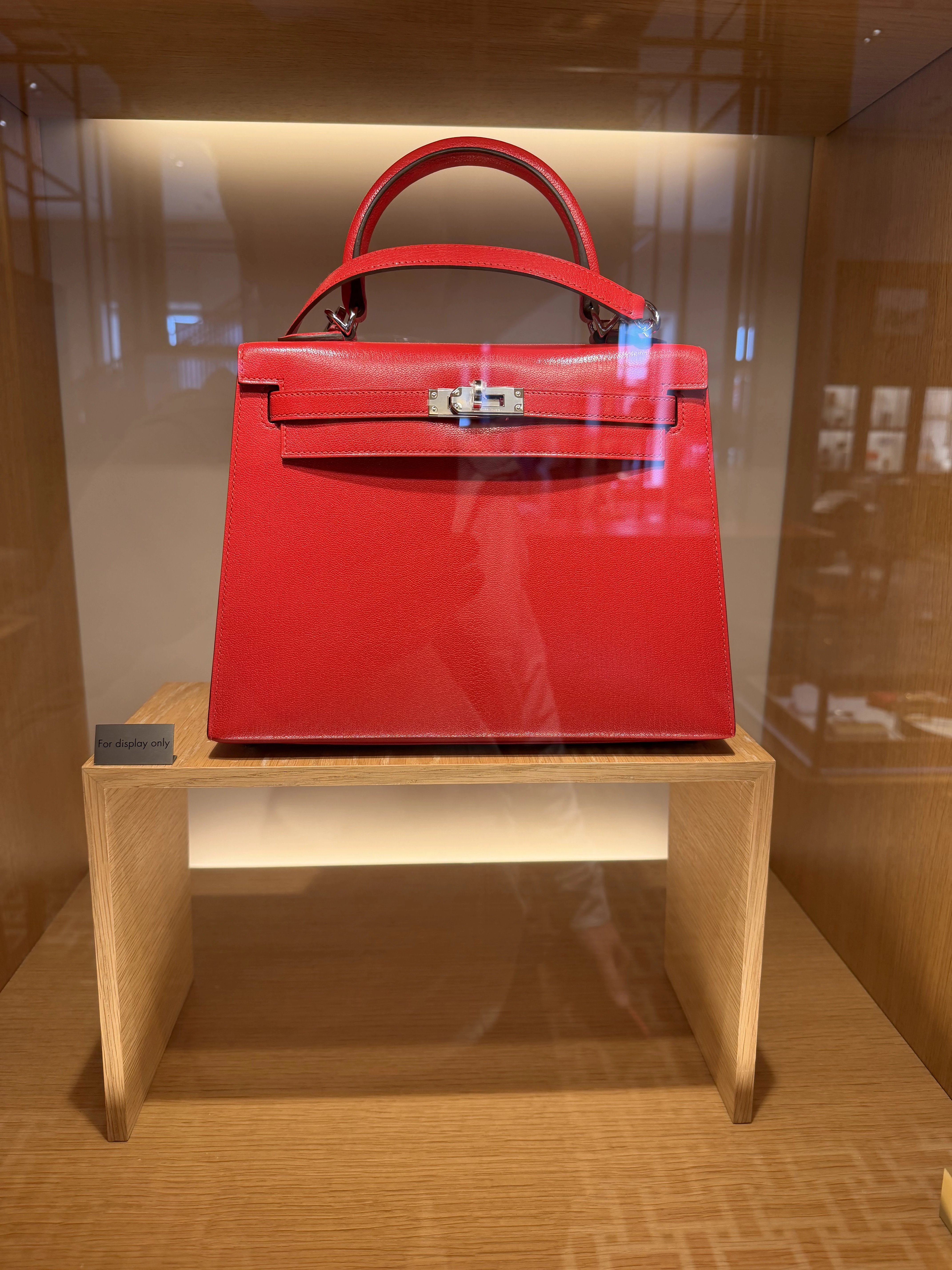
What struck me first was the tiny top handle. It looked made for fingertips, and seeing it in proportion to the structured body made the bag’s true scale much clearer than photographs ever had. Even at that size, the red Sellier did not look like a novelty or a miniature copy; it looked complete.
That small detail is the part I would remember later. Specifications can explain how wide the Mini Kelly is and resale listings can explain what collectors pay for one. Neither can fully explain the feeling of finally seeing a bag that has become almost mythical among Hermès lovers.
Why Seeing a Mini Kelly in Person Matters
Online, the Mini Kelly is usually photographed alone, centered in the frame and enlarged enough to show every stitch. Those images are useful for studying a color or comparing hardware, but they remove the context that tells your eyes how small the bag really is.
The proportions read differently when the bag is beside a hand, a phone, or a person. The handle is made for fingertips rather than the crook of an arm. The body is shallow. Even the sangles and turn lock, which look familiar from larger Kelly bags, suddenly seem delicate.
Color also becomes more complicated in person. Hermès reds can lean bright, dark, warm, cool, or slightly blue depending on the leather and light. A resale photograph taken under studio lighting may not show the same red you see near a boutique window. That is one reason the exact color name is useful, but it cannot replace seeing the leather yourself.
My brief encounter gave the bag something online images could not: scale. It let me look past the auction prices and the stories about how difficult it is to obtain one, and simply pay attention to the object in front of me.
What Exactly Is the Hermès Mini Kelly?
The modern bag most people call the Mini Kelly is the Mini Kelly II, also known as the Kelly 20 or K20. Hermès currently presents it as the Kelly II Sellier mini bag.
The Kelly itself was designed by Robert Dumas in the 1930s. Its story changed in 1956, when a photograph of Grace Kelly carrying the bag traveled around the world and helped turn it into an icon. Hermès tells that history on its own website.
Miniature Kelly designs existed before the current bag, but the redesigned Mini Kelly II arrived in 2016. It is slimmer and more sharply proportioned than earlier 20-centimeter versions. This distinction matters when shopping vintage or resale, because an older Mini Kelly and a modern Mini Kelly II are not exactly the same bag.
Mini Kelly dimensions at a glance
| Measurement | Mini Kelly II |
|---|---|
| Width | about 20 cm (7.9 in) |
| Height | about 12 cm (4.7 in) |
| Depth | about 6 cm (2.4 in) |
These are commonly published exterior measurements. Because the bag is handmade and its trapezoid shape is measured in different ways, small variations are normal. What matters most is the scale: the Mini Kelly is only about eight inches wide.
It keeps many of the Kelly’s most recognizable details:
- Trapezoid shape
- Top handle
- Two sangles across the flap
- Turn-lock closure
- Four small feet
- Removable leather strap
- One flat interior pocket
Unlike larger Kelly bags, it does not come with a padlock, key, or clochette. The current version is made in the structured Sellier construction, with exterior seams that create its crisp outline.
What Sellier Construction Changes
Sellier is more than a decorative description. Its seams are stitched so that the edges remain visible on the outside, giving the bag a firmer, more architectural shape. On a larger Kelly, shoppers can compare that formal outline with the softer, rounder Retourne construction. The current Mini Kelly II is defined by Sellier.
That structure is a large part of its appeal. The tiny flap stays precise, the side profile remains narrow, and the bag holds the little trapezoid shape that makes it immediately recognizable. On the red bag I saw, the construction gave the color clear boundaries instead of allowing the body to slouch.
There is a practical tradeoff. A structured bag does not stretch to accept one extra object, and the narrow opening can make arranging a phone and key feel like a puzzle. Corners and exterior edges also deserve care because their condition is easy to see on such a sharply outlined bag.
For the Mini Kelly, however, softness and maximum capacity are not really the point. Sellier construction is what helps make it look like a complete Kelly distilled into a much smaller form.
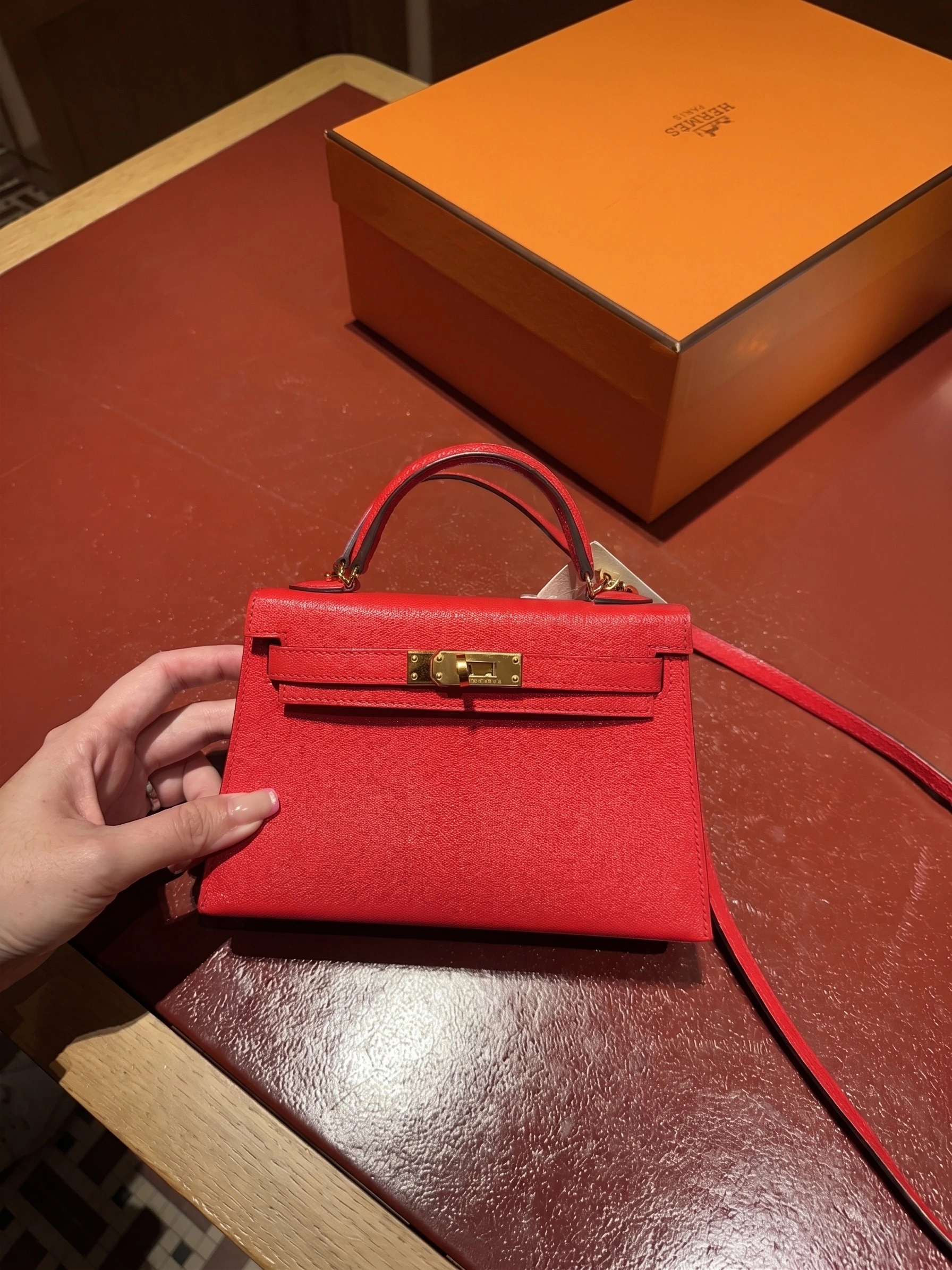
Why the Red Sellier Looked So Striking
Sellier construction already makes a Kelly look precise. On a Mini Kelly, that precision becomes even more visible because every line is compressed into such a small shape.
Red adds something different. A neutral Mini Kelly can feel quiet and jewel-like. Red makes the tiny silhouette much harder to overlook. The color emphasizes the symmetry of the flap, the little top handle, and the contrast between leather and metal hardware.
In photographs, a Mini Kelly can look like a regular Kelly without enough context to reveal its scale. A close-up photograph makes it look substantial. In person, its proportions become part of the experience.
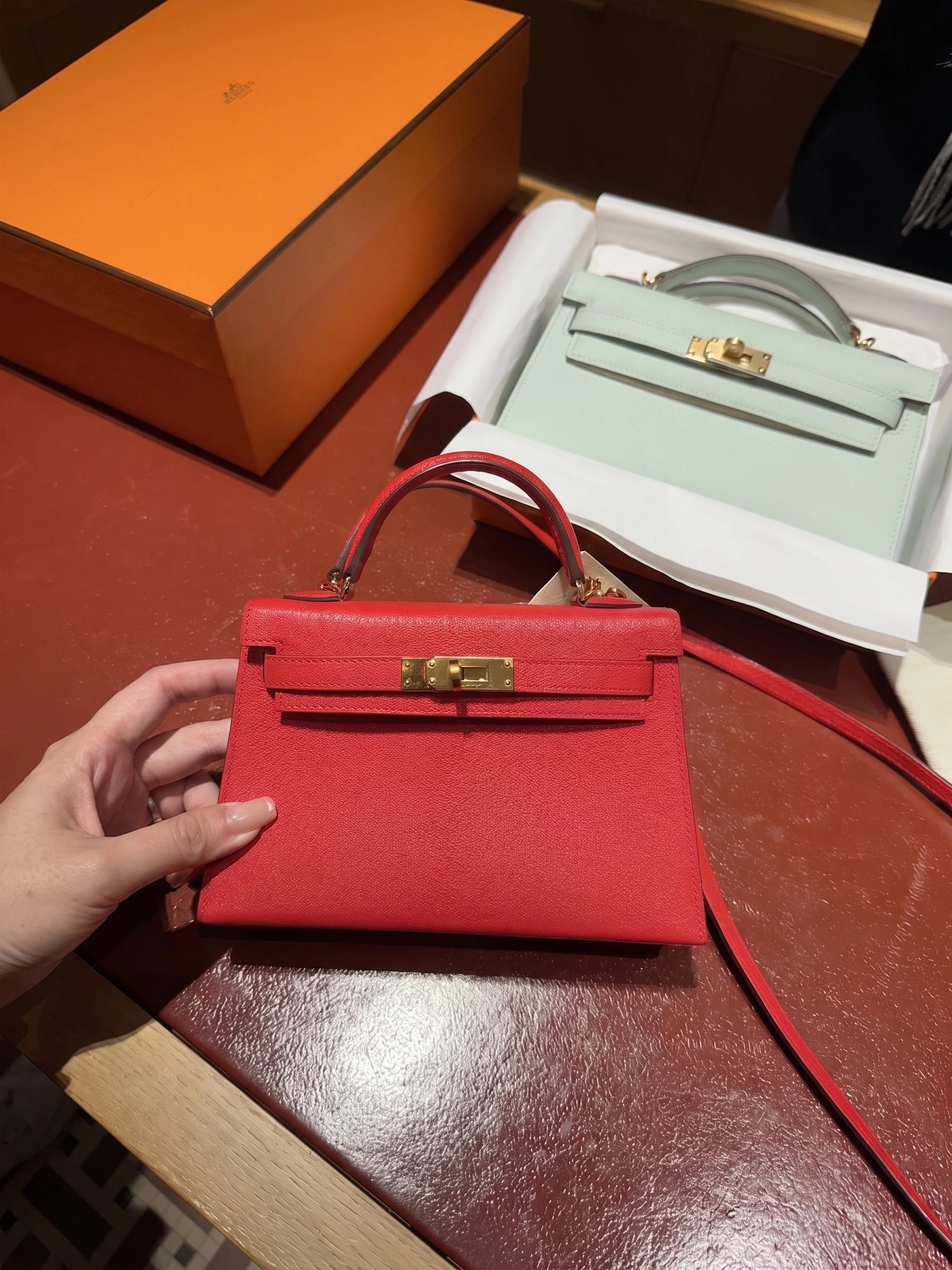
The Mini Kelly is hardly larger than a Kelly To Go wallet. The Mini Kelly measures about 20 cm wide × 12 cm high × 6 cm deep. Hermès lists the Kelly Classique To Go wallet at 19.7 cm wide × 11.5 cm high × 1.5 cm deep. Across the front, the Mini Kelly is only about 0.3 cm wider and 0.5 cm taller. Its meaningful size advantage is depth—not width or height.
For a handbag with a reported 2026 U.S. retail price of about $11,400, the Mini Kelly is certainly not spacious, and it is not as functional as many people might expect from something so expensive. Its price reflects craftsmanship, design, and rarity rather than carrying capacity. If functionality means how much a bag can hold, the Kelly To Go comparison makes the compromise impossible to miss.
What Fits Inside a Mini Kelly?
This is where admiration and practicality separate.
The Mini Kelly is not a smaller everyday Kelly. It is a genuinely tiny bag. Owner reviews commonly show room for a regular-sized phone, a very slim cardholder, a key, and one small lip product—but not much more. A large Pro Max phone often does not fit, and even a regular phone may need a thin case or no case.
The removable strap is useful, but it is not adjustable. Owners have reported different strap lengths, and several note that the bag can sit high when worn crossbody. Height, clothing, and the particular strap all affect the fit.
A realistic Mini Kelly packing list is:
- Regular-sized phone, if it fits
- Cards or a very slim cardholder
- One key or compact key fob
- Lipstick or lip balm
- Perhaps AirPods or one other very small item
Sunglasses, a large wallet, a portable battery, a full makeup pouch, and family extras are likely to require pockets—or a second bag.
My first Hermès bag was a Picotin 22, which I chose partly because it works with real life. Its open shape forgives an extra pair of glasses, keys, small electronics, and the random little things that come with having children.
The Mini Kelly asks for the opposite. It asks you to reduce the day to the smallest possible version of itself.
That should make the Mini Kelly easy to dismiss as impractical. It does not completely explain why so many people still want one.
Could a Mini Kelly Be an Everyday Bag?
For the right person, yes—but “everyday” has to mean something very specific.
If your normal carry is a regular phone, cards, one key, and lip balm, the Mini Kelly may cover an afternoon of shopping, lunch, or a short errand. Wearing the strap also keeps both hands free. Someone who already keeps a phone in a hand or coat pocket will find the bag easier to use than someone who expects every essential to remain inside it.
The limitations become clearer during a longer day. There is little room for sunglasses, a charger, a larger key ring, medication, receipts, or anything picked up along the way. A structured six-centimeter depth does not forgive overpacking. The flap and sangles are elegant, but they are also slower to open than a zip or an open-top bag.
For evenings and events, those compromises make more sense. Many people need only cards, a key, and one lip product, while a phone may already be in hand for photographs. The top handle also lets the bag work visually like a tiny formal bag once the strap is removed.
So the Mini Kelly can function as a real bag. It simply requires your life—or at least that particular outing—to fit its rules.
Why Is the Mini Kelly So Coveted?
I think four things come together.
It turns an icon into something closer to jewelry
The Mini Kelly preserves the Kelly’s recognizable shape and hardware, but its scale changes how it feels. It is less like a bag selected for capacity and more like the finishing piece of an outfit.
That also explains why strong colors work so well. A red Mini Kelly does not need to match everything or carry everything. Its job is different.
Small does not mean simple
Hermès says that making a Kelly involves assembling roughly forty leather pieces with saddle stitching, and that its bags are handcrafted in France. The Mini Kelly compresses that leatherwork into a particularly unforgiving scale. Hermès describes the Kelly-making process here.
The result feels complete rather than merely shrunken. That distinction became easier for me to understand when I could look at the red Sellier closely.
Buying one at retail is unusually difficult
Hermès states that Kelly handbags are sold exclusively in its stores. It also says that each boutique chooses its own assortment and recommends discussing availability locally. Hermès does not publish a guaranteed waiting period, spending ratio, or formula for receiving a Mini Kelly. The official availability policy is here.
That is important because many articles talk confidently about “the Hermès game.” Individual shoppers can describe their own experiences, but those experiences do not create a universal rule.
Every combination feels collectible
The Mini Kelly appears in Epsom and Chèvre leathers, Box calfskin, ostrich, alligator, crocodile, special orders, and limited editions. Then there are the colors, contrasting interiors, stitching, and hardware combinations.
At this scale, each variation can feel like a separate object rather than simply another version of the same practical bag. A collector may admire a neutral Mini Kelly for one reason and a bright red Sellier for another.
How Much Does a Mini Kelly Cost in 2026?
Because the Mini Kelly is not listed for ordinary online purchase, current retail pricing comes from reported boutique purchases and collector price guides rather than a permanent Hermès product page.
Reported 2026 boutique pricing places a Mini Kelly II in Epsom leather at approximately $11,400 in the United States. Other leathers, exotic skins, and special editions cost more. Prices also change, so this should be treated as a dated reference rather than a permanent price.
The secondary market is a different world. Pristine leather Mini Kelly IIs often trade around $30,000, with auction prices commonly around $25,000 to $30,000 depending on color, condition, hardware, and date stamp. Rare leathers and limited editions can go much higher.
That premium is evidence of demand, but I would not call any handbag a guaranteed investment. Resale companies have a commercial interest in emphasizing value, asking prices are not the same as completed sales, and tastes can change. Buy the bag because you want the bag—not because a chart promises a return.
What the Resale Premium Really Buys
Boutique and resale shopping solve different problems.
At an Hermès boutique, the retail price is lower and the offer becomes part of the experience. The difficult part is that wanting a Mini Kelly does not mean the store will have one available, and availability does not mean it will be the color, leather, and hardware combination you imagined. There is no official menu from which a new shopper can simply order the exact bag.
The resale market reverses that tradeoff. A buyer can search directly for red Epsom with gold hardware, a neutral Chèvre with palladium hardware, or another precise combination and purchase it without waiting for a boutique offer. The premium pays for choice and immediate access; it does not make the underlying bag more beautifully made.
Resale also creates different work for the buyer. Condition descriptions, corner wear, hardware scratches, included accessories, seller reputation, return terms, and authentication all matter. An asking price should be compared with completed sales when possible, because a bag displayed at $35,000 has not necessarily found a buyer at that number.
For someone flexible about color, a boutique offer may be the dream. For someone whose heart is set on one exact red, resale may provide more control—but at a very visible cost.
Is the Mini Kelly Worth It?
If “worth it” means maximum capacity for the price, the answer is clearly no.
If it means craftsmanship, rarity, a recognizable design, and the pleasure of carrying something that feels more like a small jewel than an everyday bag, the answer becomes personal.
That is why seeing the red Sellier in San Francisco mattered to me. Until then, the Mini Kelly was an image repeated online: tiny bag, impossible offer, enormous resale price. Up close, I could pay attention to the object itself.
For me, [PERSONAL VERDICT].
The Mini Kelly may be one of the least practical bags Hermès makes. It may also be one of the clearest examples of why practicality is not the only reason people fall in love with a bag.
Frequently Asked Questions
Is the Mini Kelly the same as a Kelly 20?
The modern Mini Kelly II is commonly called the Kelly 20 or K20 because it measures approximately 20 centimeters across its base. Vintage Mini Kelly variations have different proportions, so check the production period when shopping resale.
Does an iPhone fit inside a Mini Kelly?
A regular-sized iPhone can fit, although a thick case reduces the remaining space. Pro Max phones generally do not fit comfortably. Phone dimensions change, so test your exact phone before assuming.
Is the Mini Kelly only available in Sellier construction?
The current Mini Kelly II is produced in the structured Sellier style. Vintage miniature Kelly bags can have different shapes and construction.
Does the Mini Kelly come with a shoulder strap?
Yes. The Mini Kelly II has a removable leather strap, but it is not adjustable. Depending on the strap and the wearer’s height, it may sit high when worn crossbody.
How much is a Mini Kelly in the United States in 2026?
Collector price guides report approximately $11,400 for an Epsom Mini Kelly II in 2026. This is a dated, third-party-reported price; leather, material, and future Hermès increases will change it.
Can you buy a Mini Kelly online from Hermès?
No. Hermès states that Kelly handbags are sold exclusively in its stores. Mini Kelly bags seen online are generally offered through auction houses or resale businesses.
Why is the Mini Kelly so hard to get?
Demand is high and boutique availability is limited. Hermès does not publish inventory numbers, waiting periods, or a guaranteed purchase-history formula, so no outside source can promise a particular path to an offer.